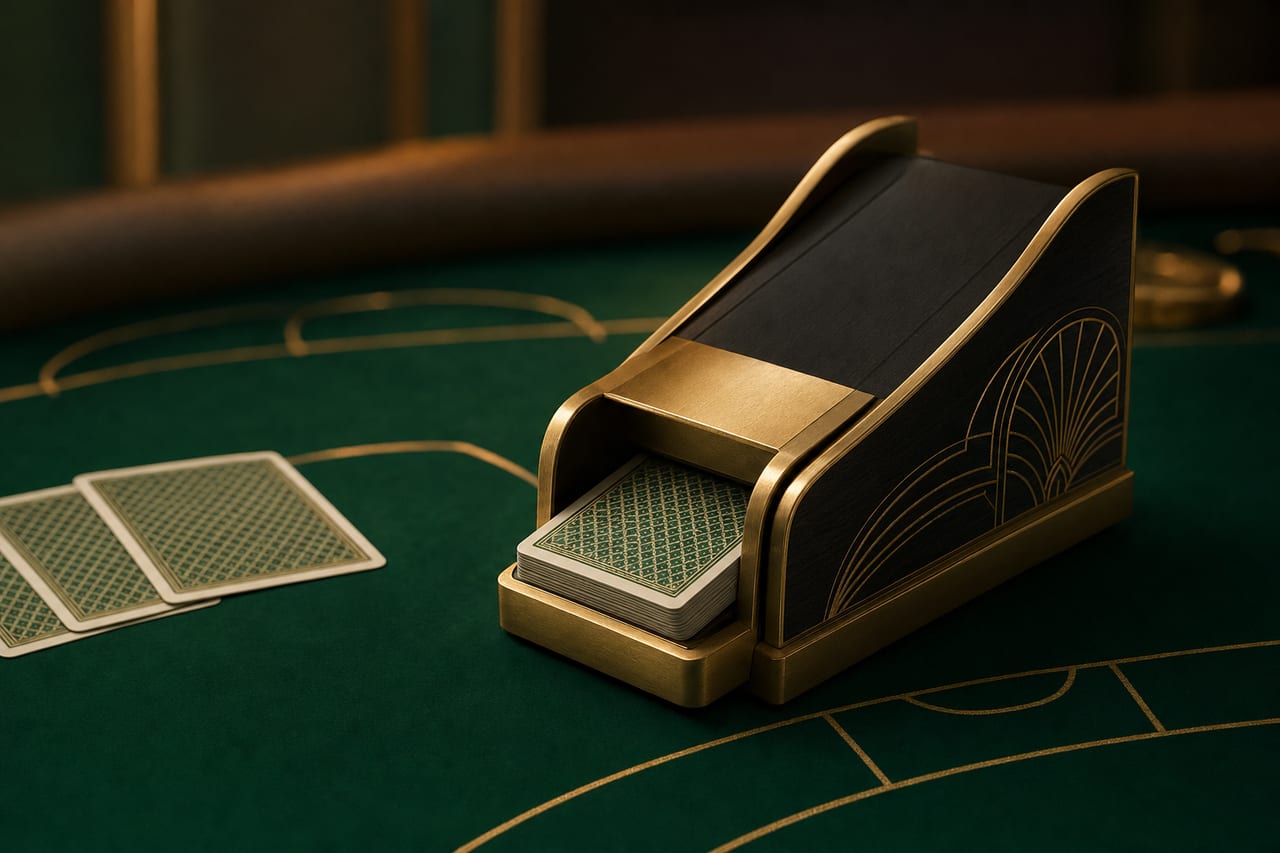
Two hands - Player and Banker - each get two cards. The hand closer to nine wins. Tens and court cards count as zero, totals over nine drop the first digit, and a possible third card is drawn by fixed rules the dealer applies automatically.
The objective
Baccarat could not be simpler at heart: you bet on which of two hands - Player or Banker - will total closer to nine, or that they will tie. You never hold cards or make playing decisions. Once your bet is down, the outcome is fixed by the rules below.
Card values
Add the cards and, if the total is ten or more, drop the first digit: a 6 and an 8 total 14, which scores 4. The highest possible total is nine.
How a round plays
- Bets are placed on Player, Banker or Tie.
- Two cards go to each hand, face up.
- A total of 8 or 9 on either hand is a natural - both hands stand and the round is decided.
- Otherwise, the third-card rules decide whether each hand draws one more card.
- The hand closer to nine wins. Player and Banker pay even money (Banker less commission); a tie pushes those bets.
The third-card rule
- Player: draws a third card on 0-5, stands on 6-7.
- Banker: depends on its total and the Player’s third card (table below).
- Banker acts last, with more information - the source of its small edge.
If the Player stood (no third card), the Banker simply draws on 0-5 and stands on 6-7. If the Player drew a third card, the Banker follows this table:
| Banker total | Draws a third card if Player’s 3rd card is… |
|---|---|
| 0 – 2 | Always draws |
| 3 | Any card except 8 |
| 4 | 2, 3, 4, 5, 6 or 7 |
| 5 | 4, 5, 6 or 7 |
| 6 | 6 or 7 |
| 7 | Always stands |
Payouts & commission
- Player win - pays 1:1 (even money).
- Banker win - pays 1:1 minus a 5% commission, so a £10 win returns £9.50 profit.
- Tie - pays 8:1 (occasionally 9:1); Player and Banker bets push when a tie lands.
That commission is not a catch - it is the mechanism that keeps Banker from being an unbeatable bet. See exactly what each option costs in our house-edge calculator, or watch the rules play out in the free trainer.